 Chocolate Tours Brussels
Belgian Chocolate: What Makes It Special
Belgian chocolate is chocolate made under rules that go back to 1894, when Belgium set a minimum of 35 percent pure cocoa. This page explains what makes chocolate Belgian, from the Belgian Chocolate Code of 2007 to the filled praline Neuhaus created in 1912. It covers the big brands such as Cote d'Or, Neuhaus, Leonidas, Godiva and Guylian, the artisans, the production and export figures, and how to taste and store what you buy. If you want the shops themselves, see the guide to the best chocolate in Brussels. To taste your way through the story in person, the Brussels Tasting Tour of Guide-Picked Artisan Chocolatiers costs $34 per person for 1.5 hours and five tastings. The bookable tours are compared on Brussels chocolate tours.
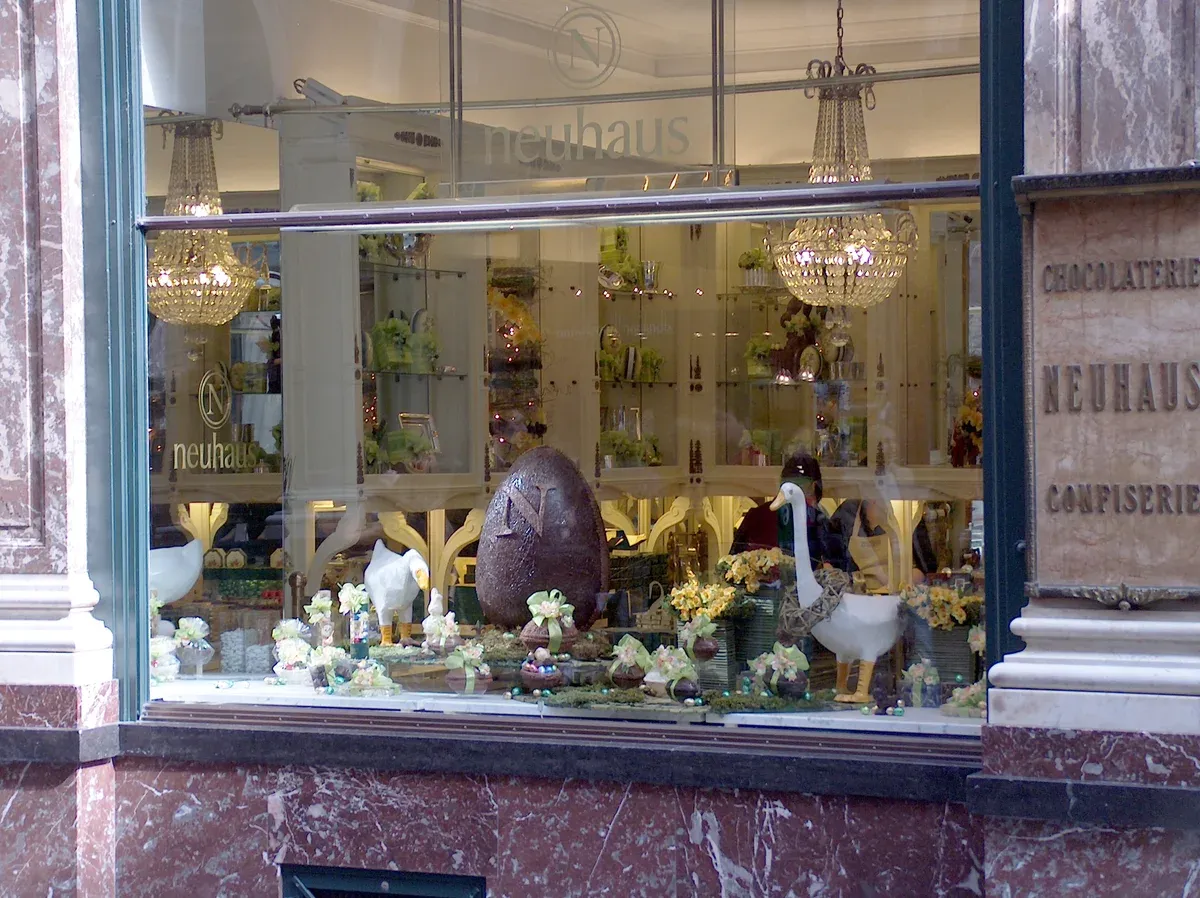
A Neuhaus shop window in central Brussels. Photo: Wikimedia Commons, CC BY-SA 2.0 be, via Wikimedia Commons
Quick answer Belgian chocolate in brief
Belgian chocolate is chocolate governed by an 1894 law requiring at least 35 percent pure cocoa, and since 2007 by the Belgian Chocolate Code, a voluntary standard followed by about 90 percent of Belgian chocolate makers. Belgium produces almost 220,000 tonnes of chocolate a year, according to Focus on Belgium, and Brussels Times puts its exports at $3.1 billion, about 11 percent of world exports. Neuhaus created the filled praline in Brussels in 1912.
Key takeaways
- The 2007 Belgian Chocolate Code requires refining, mixing and conching to happen inside Belgium. See what makes it Belgian.
- Neuhaus created the filled praline in 1912 and the ballotin gift box followed in 1915. See the history.
- Want to taste it as you learn? The Small Group Chocolate Tasting caps groups at 10 and costs $55.95 per person for 2 hours.
- Planning a visit around the tastings, the museums and the workshops? Compare the chocolate tours in Brussels and see the Choco-Story Brussels guide.
What Makes Chocolate Belgian
Two things set Belgian chocolate apart: a law from 1894 and a voluntary code from 2007. Together they set a cocoa floor and a production geography that other countries do not match.
The 35 Percent Cocoa Rule
Belgium started regulating chocolate in 1894 with a minimum of 35 percent pure cocoa. A 2003 EU regulation on cocoa butter substitutes was seen in Belgium as too lenient compared with traditional standards. So when you pick up a box in Brussels, the legal floor is 35 percent cocoa.
| Year | Rule or event |
|---|---|
| 1894 | Belgian regulation begins, with a minimum of 35 percent pure cocoa |
| 2003 | EU regulation on cocoa butter substitutes seen in Belgium as too lenient |
| 2007 | Belgian Chocolate Code, a voluntary standard followed by about 90 percent of Belgian chocolate makers |
The Belgian Chocolate Code of 2007
The Belgian Chocolate Code dates from 2007. It is voluntary, and about 90 percent of Belgian chocolate makers follow it. Its key requirement is geographic: refining, mixing and conching must all be done inside Belgium.
In practice, chocolate made under the Code is processed in Belgium, not just packaged there.
Why the Rules Matter When You Taste
The shared rules do not make every Belgian praline identical. Leonidas makes its chocolate with cocoa butter and no palm oil. Galler says its cocoa is 100 percent fairtrade.
Those are brand choices on top of the shared rules. A good way to feel the difference is a guided walk that moves between houses, such as the artisan chocolate tasting tour, a 1.5-hour walk from Grand Place with five tastings for $34 per person. Tasting back to back is how the shared baseline and the individual styles separate out.
The Numbers Behind the Label
Belgium produced 172,000 tonnes of chocolate in 2012 with over 2,000 chocolatiers, per Wikipedia. Focus on Belgium puts output at almost 220,000 tonnes a year and counted 500 chocolatiers and 2,000 chocolate shops in 2012, about one shop for every 5,500 inhabitants. Belgians eat about 8 kg of chocolate each per year, one in five Belgians eats chocolate daily, and Belgium ranks third in the world for chocolate consumption after Germany and the UK.
On exports, Brussels Times puts Belgian chocolate exports at 3.1 billion dollars, about 11 percent of global exports. The country has exported more chocolate than it imported since the 1960s. Brussels Airport alone sells over 800 tonnes a year and is described as the world's largest chocolate outlet.
Preferences at home split 49 percent milk chocolate, 37 percent dark and 14 percent white.
Ruby Chocolate
Barry Callebaut introduced ruby chocolate on 5 September 2017 after developing it from 2004. Ruby is pink, made from cocoa butter, cocoa mass, milk, sugar and citric acid, and it tastes slightly sweet and sour, like berries.
Tasting and Storing It Properly
Belgians themselves split between milk at 49 percent, dark at 37 percent and white at 14 percent. Storage matters as much as order. Neuhaus advises keeping chocolate at 58 to 64 F (14 to 18 C), away from sunlight, and not in the fridge.
Brussels has an oceanic climate with July average highs around 23 C. Neuhaus guarantees at least four weeks of shelf life on online orders, and it only offers free standard US shipping to destinations below 75 F, which shows how seriously warm weather is taken. If you buy a box in summer, carry it in an air-conditioned room rather than a hot car.
From the Congo to the Praline
Belgian chocolate's story runs from the Spanish occupation in 1635 to a Brussels pharmacy counter in 1912, with the Belgian Congo standing at the centre of the supply chain in between.
The Timeline
The dates below are the spine of the story. Two of them carry a dispute: sources differ on who at Neuhaus made the 1912 praline, with Wikipedia naming Jean Neuhaus II and VRT naming Jean Neuhaus Jr. Both point to the Neuhaus family shop in the Galerie de la Reine, but the generation differs. On the Leonidas founding year the sources also split, Wikipedia giving 1913 and VRT giving 1924, so the table records the Wikipedia figure and flags the conflict.
| Year | What happened |
|---|---|
| 1635 | Chocolate entered Belgium during the Spanish occupation |
| 1857 | Jean Neuhaus, a Swiss immigrant, opened an apothecary at the Galeries Royales near the Grand-Place |
| 1883 | Cote d'Or founded by Charles Neuhaus in Schaerbeek |
| 1912 | The Neuhaus house created the first filled pralines |
| 1913 | Leonidas founded by Leonidas Kestekides, per Wikipedia |
| 1915 | The ballotin gift box was developed at Neuhaus |
| 1926 | Godiva began in a Brussels home workshop under Pierre Draps |
| 1958 | Guylian founded in Sint-Niklaas by Guy Foubert |
Chocolate Arrives, Then the Congo Changes the Price
Chocolate entered Belgium in 1635 during the Spanish occupation, when Brussels was the administrative centre of the Spanish Netherlands. By the mid-18th century hot chocolate was popular among the upper and middle classes. The bigger shift came in the early 20th century, when Belgium began importing large quantities of cocoa from the Belgian Congo, which existed as a colony from 1908 to 1960 after the Congo Free State that King Leopold II ran as a personal possession from 1885 to 1908.
The Congo supply made chocolate cheaper for working-class Belgians. Cocoa was grown in the Congo, though rubber, cotton and palm oil dominated its farming. The colonial record is a hard part of the story.
The Praline and the Box That Saved It
The praline as known today was developed in 1912 at Neuhaus, where the medicinal core was replaced with cream, according to VRT. The first Neuhaus shop had sold cough drops, marshmallows and licorice for stomach ailments, and Jean Neuhaus reportedly coated medicines in chocolate to mask their taste. Three years later, in 1915, Louise Agostini developed the ballotin gift box, made because pralines were getting crushed inside paper cornet bags.
The original shop is in the Galeries Royales Saint-Hubert and remains one of the most-visited chocolate shops in Belgium, or taste the modern pralines on the small group chocolate tasting tour, which starts inside those same galleries and costs $55.95 per person for a 2-hour walk of at least 7 pralines and truffles in a group capped at 10.
The Big Names
Belgium's chocolate shelves are shared between a handful of large houses and more than 2,000 chocolatiers. These are the brands with the deepest roots, based on what public records and the companies themselves state.
Neuhaus
Neuhaus is the house that created the filled Belgian praline. Swiss immigrant Jean Neuhaus opened an apothecary shop in 1857 at the Galeries Royales near the Grand-Place, and La Libre places it at numbers 25-27 of the Galerie de la Reine. The first shop sold medicinal candies such as cough drops, marshmallows and licorice for stomach ailments.
The house created the first filled pralines in 1912. King Albert II granted the title of Certified Supplier to the Court of Belgium in 2000. Production today happens in Vlezenbeek near Brussels, and the brand counts over 1,500 selling points in 50 countries.
The original Galerie de la Reine shop is still one of the most visited chocolate shops in Belgium. The artisan chocolate tasting tour passes the Royal Galleries.
Côte D'Or
Côte d'Or was founded in 1883 by Charles Neuhaus in Schaerbeek, and the name means Gold Coast, a reference to Ghana, the source of its cacao. The elephant logo dates from 1906 and was borrowed from a Ghana stamp by Lambert Michiels. The company was sold to the Buiswal-Leclef family in 1889, merged with Michiels in 1906 to form Alimenta, went to Jacobs Suchard in 1987 and to Kraft General Foods in 1990, and has belonged to Mondelez International since 2012.
From 1940 to 1946 it sold a cheaper wartime brand called Congobar because of cocoa shortages. Belgians eat about 600 million Côte d'Or products a year, and the Halle factory once turned out about 1.3 million small bars and two million Chokotoff candies a day.
Leonidas
Leonidas carries a date conflict worth knowing. Wikipedia says it was founded in 1913 by Leonidas Kestekides, born in 1882 in Nigde, Turkey, of Greek heritage, while VRT lists 1924. The company was registered in Brussels in 1937 at 58 Boulevard Anspach after moving from Ghent.
Its signature product is the manon, a buttercream chocolate on a white chocolate praline base, and the logo shows King Leonidas I of Sparta in honour of the founder's Greek roots. In 2019 it had more than 1,030 points of sale in 32 countries, about 450 of them in Belgium and Luxembourg, most as franchises with about 40 company owned. It uses cocoa butter and no palm oil.
The factory outlet at Boulevard Industriel 8 in Anderlecht sells 1 kg boxes for between €18 and €23 according to Brussels Times.
Godiva
Godiva was founded in 1926 in Brussels by Pierre Draps, who began making pralines in a home workshop and sold them through the Sarma department store. The Draps brothers opened their first shop in Koekelberg on Boulevard Leopold II, with a second in Knokke less than six months later. The name came in 1945 according to Wikipedia, drawn from Lady Godiva, an idea of Joseph Draps' wife Gabrielle, though Godiva's own history puts the naming a year later.
The main operations now belong to Yildiz Holding of Turkey. It still ranks among the largest Belgian chocolate manufacturers alongside Neuhaus, Côte d'Or, Leonidas and Guylian.
Galler
Galler is the youngest of the big names. Jean Galler founded it in 1976 and the house is based in Liege, with a Brussels shop at Rue au Beurre 44 near the Grand-Place. It is known for filled chocolate bars and playful flavours The company states that its cocoa is 100 percent fairtrade.
For tasting your way through several houses in one walk rather than choosing between bars, chocolate tours in Brussels cover the independents as well as the brands.
Guylian
Guylian was founded in 1958 in Sint-Niklaas by Guy Foubert, and the name joins Guy and Liliane Foubert. Its core product is the seashell shaped praline with a roasted hazelnut filling, and its symbol is a seahorse whose tail curls the opposite way to a real seahorse. The Sint-Niklaas factory can produce up to 75 tons of chocolate a day and the brand exports to about 120 countries.
Lotte Confectionery bought it in June 2008 for 105 million euros. From 2005 to 2011 it held the record for the largest chocolate Easter egg at 8.32 metres tall.
Callebaut
Callebaut is the house behind the scenes. The family brewery in Wieze was founded by Eugene Callebaut as Brouwerij De Ploeg, which Belgian Smaak dates to 1838 and Wikipedia to 1850. Octaaf Callebaut turned the business to chocolate in 1911, couverture production began in 1925, and the callets that chocolatiers melt by the handful arrived in 1988.
Cacao Barry, founded in France in 1842, merged with Callebaut in 1996 to form Barry Callebaut, now based in Zurich. The Wieze plant is the largest chocolate factory in the world, makes about 1,000 tonnes a day, runs 24 hours a day and ships 30 to 40 trucks of liquid chocolate daily. Barry Callebaut also introduced ruby chocolate in 2017 after developing it from 2004.
Big Brands Versus the Artisans
The brands above are among the largest manufacturers, but they are only half the story. Focus on Belgium counted 500 chocolatiers and 2,000 chocolate shops in 2012, roughly one shop for every 5,500 inhabitants, and houses such as Mary, founded in 1919 by Mary Delluc on rue Royale, or Wittamer, founded in 1910 on the Grand Sablon, hold the Belgian Royal Warrant. Côte d'Or held 21 percent of Mondelez's Belgian chocolate value share in 2013.
Where to buy each one, and which shops to prioritise, is covered in the best chocolate in Brussels guide.
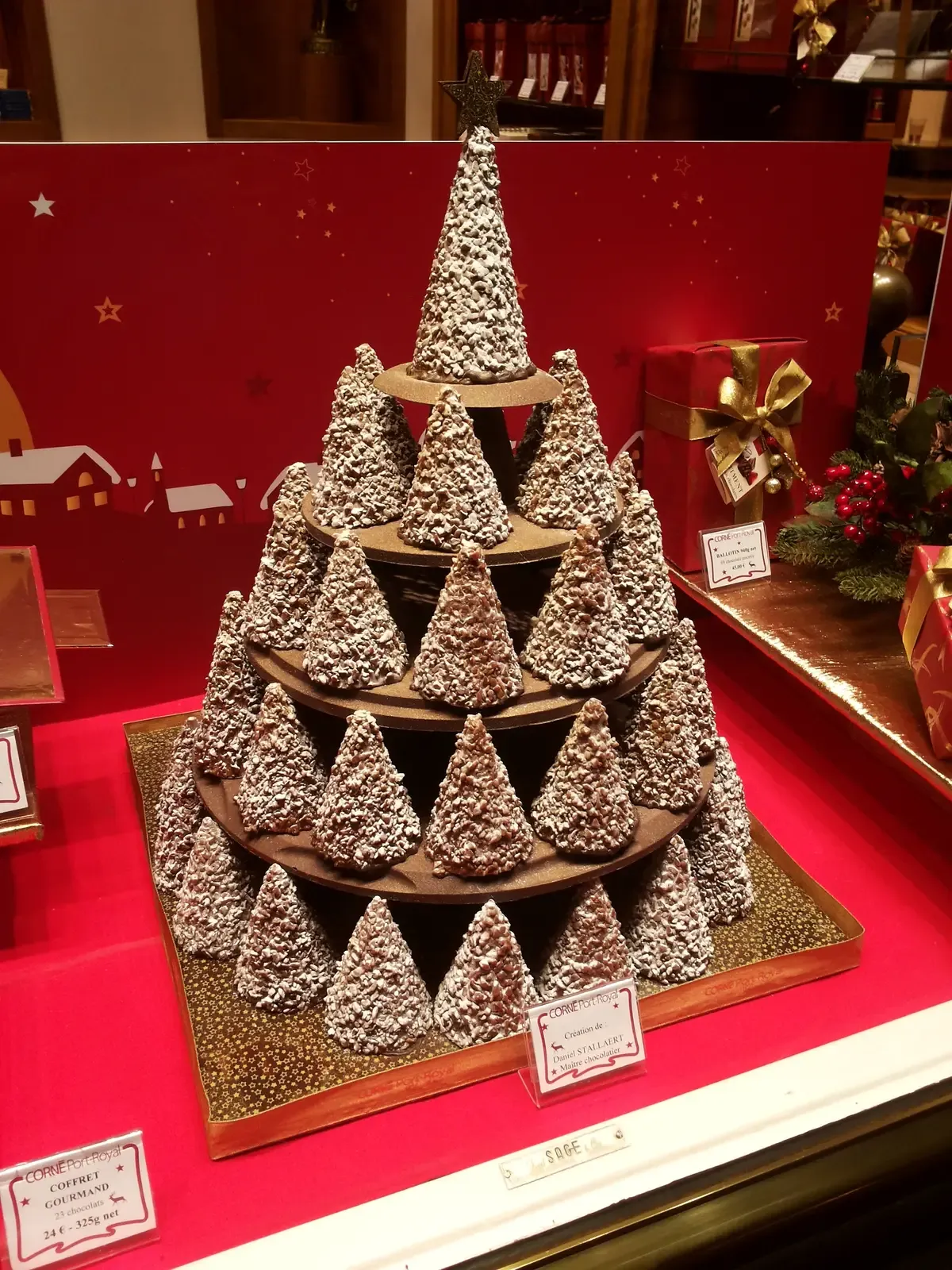
A chocolate tower displayed in a Brussels shop at Christmas. Photo: Romaine, CC0, via Wikimedia Commons
The Belgian Praline
The word praline means two different sweets on either side of the border, and the Belgian version is the younger and the more famous one.
What a Belgian Praline Is
In Belgium a praline is a chocolate shell with a soft filling. Neuhaus is credited with the first chocolate-filled bonbons in 1912, and VRT reports that the medicinal core of the family's coated remedies was replaced with cream. The accounts differ on the name: Wikipedia traces the Neuhaus line from founder Jean to son Frederic to grandson Jean II, who made the 1912 praline, while VRT calls the inventor Jean Neuhaus Jr., the founder's grandson.
The Ballotin
Fresh pralines travelled badly. They were sold in paper cornet bags and got crushed on the way home, so Louise Agostini, wife of Jean Neuhaus II, developed a stiff gift box in 1915 that became known as the ballotin. VRT credits her with the design three years after the 1912 praline, while Wikipedia describes the couple developing it together.
The box holds each praline in place so the filling survives the trip. When you buy pralines to carry home, ask for a ballotin rather than a paper bag. The two-hour small group chocolate tasting visits five shops from a meeting point inside the Royal Galleries.
Tasting and Keeping It
Belgian chocolate is sensitive to heat and to cold, and the tasting order matters as much as the storage.
How to Store It
Neuhaus advises storing chocolate at 58 to 64 F (14 to 18 C), away from sunlight and not in the fridge. The city has an oceanic climate with July average highs around 23 C and about 135 rainy days a year. Neuhaus guarantees at least four weeks of shelf life on online orders, which is the clearest official figure on how long filled chocolates keep, and its free standard US shipping only applies to destinations below 75 F, showing how seriously warm weather is treated.
How to Taste It
Belgian preferences run to milk chocolate, with 49 percent of Belgians preferring it, 37 percent dark and 14 percent white, according to Brussels Times, and one in five Belgians eats chocolate daily. Belgium ranks third in the world for consumption after Germany and the UK, and Belgians eat about 8 kg each a year. If you want a structured version of this with a guide deciding the order, Brussels chocolate tours build it in for you.
Tasting Walks That Cover the Classics
The cheapest way to taste across several chocolatiers is the artisan chocolate tasting tour at $34 per person, a 1.5-hour walk from Grand Place with five tastings of pralines, truffles and ganache. The small group chocolate tasting at $55.95 per person caps the group at 10 and gives at least 7 pralines or truffles across 5 shops in 2 hours. For chocolate plus beer, the beer and chocolate tour costs $113.04 per person over 4 hours with 10 chocolate tastings and at least 5 beers.
None of these tours lists museum admission.
Sources: Wikipedia, Neuhaus FAQ
Frequently Asked Questions
What is the most famous chocolate in Belgium?
Neuhaus is the most historically famous because it created the filled praline in 1912, while Côte d'Or is the most eaten, with Belgians consuming about 600 million Côte d'Or products a year. For tastings, see the chocolate tours Brussels comparison.
Which brand is the best Belgian chocolate?
There is no single best. Neuhaus, Côte d'Or, Leonidas, Godiva and Guylian rank among the largest manufacturers, but houses such as Mary, with the Royal Warrant since 1942, compete at the counter. A guided tasting walk is the fairest way to compare them side by side.
What is a Belgian praline?
It is a chocolate shell with a soft filling, created at Neuhaus in 1912, where a medicinal core was replaced with cream. The artisan tasting tour offers five tastings of pralines, truffles and ganache.
Why do Belgian pralines come in a box?
Because paper cornet bags crushed them. Louise Agostini developed the ballotin gift box in 1915, three years after the praline, to hold each chocolate in place. The chocolate tours in Brussels pass the shops that sell them.
How long do Belgian pralines keep?
Neuhaus guarantees at least four weeks of shelf life on online orders, which is the only firm figure from the sources. Keep the box at 14 to 18 C, out of sunlight and out of the fridge. After a tasting tour buy your box fresh on the day you travel.
Does Belgium make anything besides dark and milk chocolate?
Yes, Barry Callebaut introduced ruby chocolate in 2017 after developing it from 2004. It is pink, contains cocoa butter, cocoa mass, milk, sugar and citric acid, and tastes slightly sweet and sour like berries. The beer and chocolate tour adds another axis, pairing 10 chocolate tastings with at least 5 beers.